Most visitors to Croatia go to Istria, our largest and westernmost peninsula, for its coast, for Roman amphitheatre in Pula, for Brijuni Islands, for beautiful Rovinj, or for Unesco-protected Basilica in Porec, but not everybody thinks that they should venture into hinterland, oblivious to all the beauty it hides.
Last December my husband and I went to Istria for a weekend, and once again we decided to stay at the coast overnight, but to focus our interest on the interior of the peninsula, on the sights and paths that we had missed on our previous trips. This time the route was to take us from Opatija to Rovinj via Svetvinčenat and Dvigrad.
Map of Istria with a drawn route we took that day
We are always happy to revist Istria for its colours, architecture, cuisine and its proximity and semblance with Italy, but this is the first time we got a chance to see it in winter time; its land dry, trees fruitless, branches swept by winds, but the warm sunshine that day painted the remaining leaves nice golden shade and we were happy leaving the smog of the capital behind.
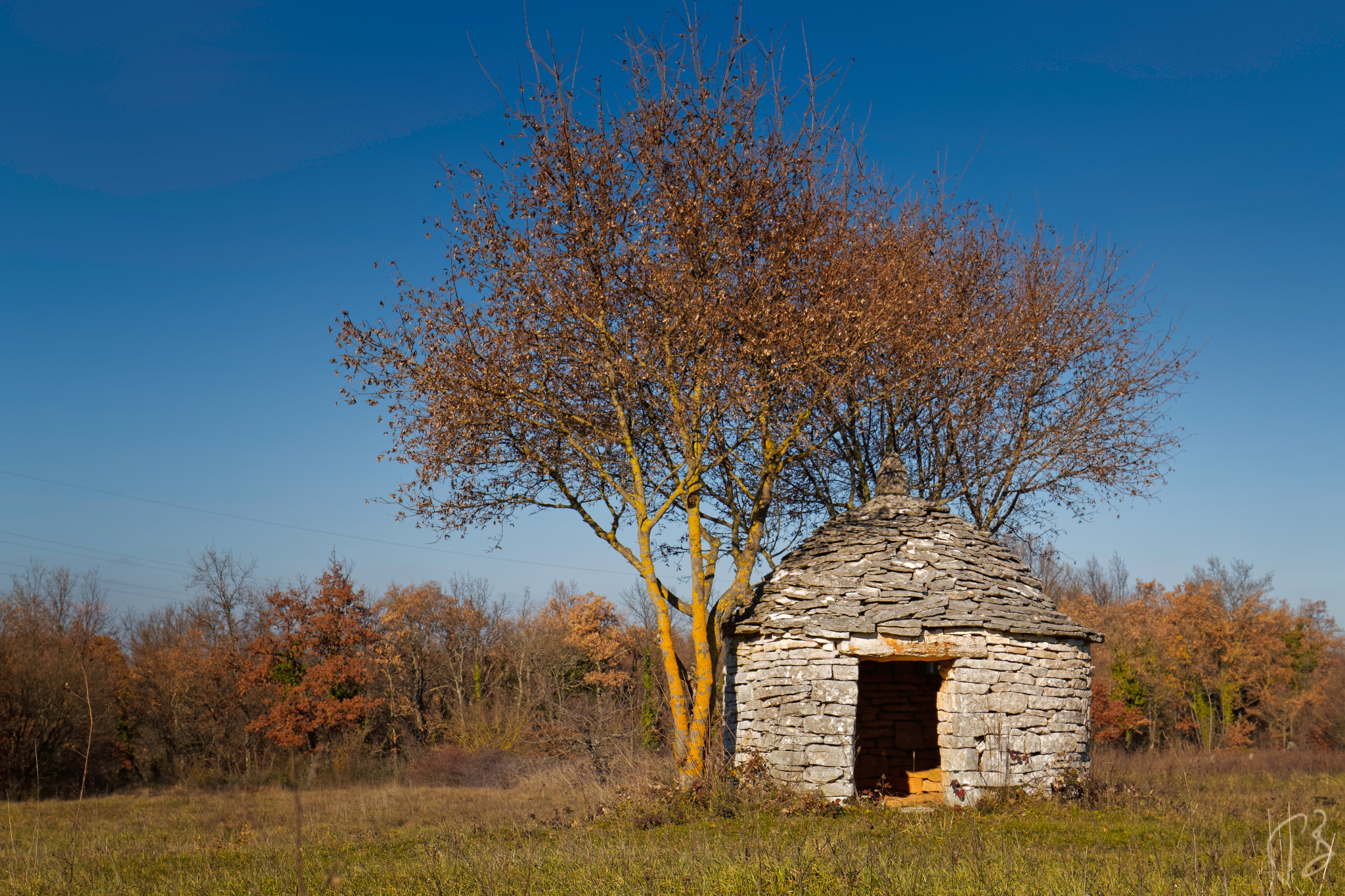
Our first unplanned stop is by the road where I spotted a traditional shepherd’s hut, made of stone (drywall). Kazuni have been in use for centuries, once as shelters (for shepherds), later for storing agricultural tools, and reportedly the same type of structures were used as dwellings in prehistory.
KAZUN – typical shepherd’s shelter in Istria
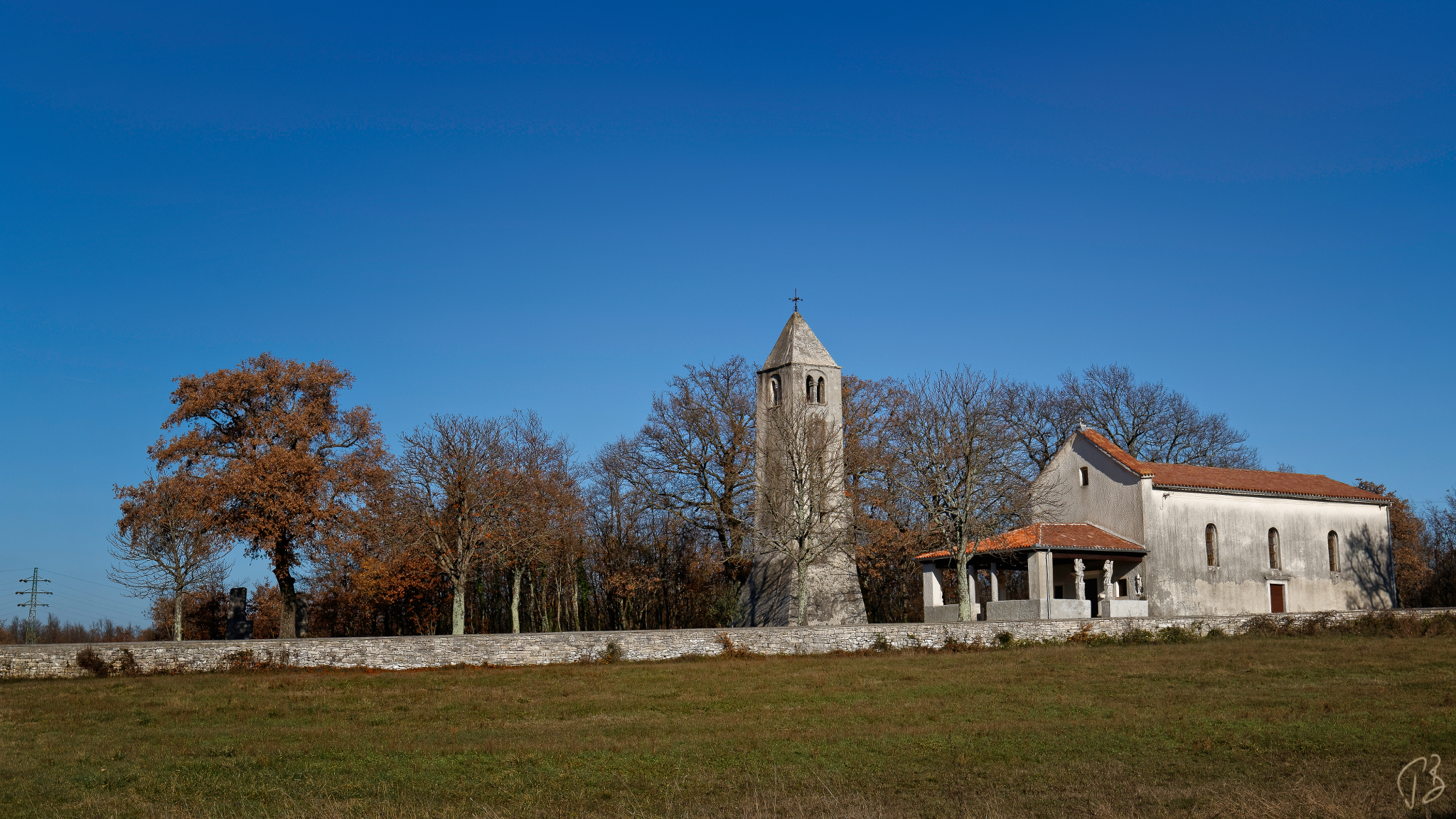
On the other side of the road stands a small country church built in the same style as many Istrian sacral buildings. Still, it was unusual to see it placed along the road with no villages or houses nearby.
A little church I know nothing about near Svetvinčenat, Istria
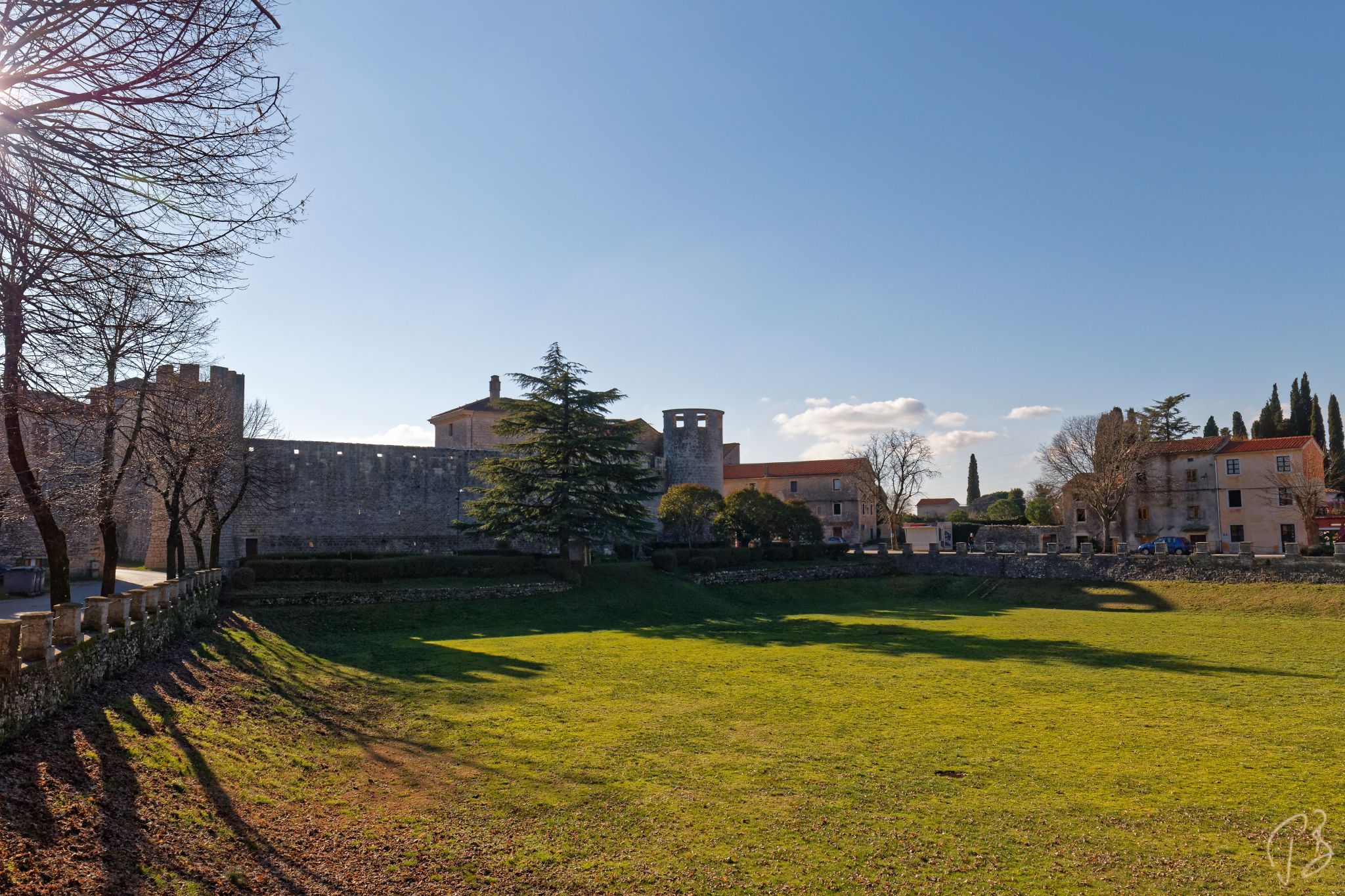
Half an hour later we are already in Svetvinčenat, a fascinating little town featuring a regular, square piazza closed in by the Parish Church, city loggia, several Renaissance houses and the monumental Castle Morosini-Grimani. This Medieval jewel was built as a square fortification with round towers and simple façade. In the 15th ct it was owned by the Morosini family who enlarged it while adding it some Renaissance features. On the other side of the square the quaint Parish church of St Mary’s Assumption is decorated with a distinctive Renaissance trefoil façade.
A shooting star ornament on the church was signalling that Christmas was just two weeks apart, but the place was magically quiet, with no people (and much less tourists) in sight, and we felt as the only breathing people there.
Svetvinčenat, Istria
Svetvinčenat, detail
Castle Grimano in Svetvinčenat
The sunlight was harsh and glaring, contrasts too strong, and I knew that photos would be nothing to brag about, but I was excited to be finally exploring what seems to be one of the most scenic places in Istria.
I love winter, its quietness, crisp air and low-lying sun, but the day is getting too short and we have to move quickly to make time for other stops on our way.
Ah ha! So that’s where patulous was! I loved that image, as so many of your others, Paula. 🙂 🙂 I know that, being a perfectionist, you will never willingly give less than your best and I love that you have gone to so much trouble to walk with me. Some day I’ll make it back to Croatia. Sending hugs, darlin.
That looks like a wonderful trip to take, Paula (I have made a note!)
I love the first image – wonderful light and peace. And the vintage shot is great too – and perfectly accompanied by the ethnic music
Thank you for taking me on your travel. I want to go back to Croatia and see more than I did last time. Istria looks lovely. I love the shepherds hut.and the music to listen to as I read and write 😀
It was 2009 on an organised tour, my first overseas trip. We stopped at Rovinj where I had my first taste of Dalmation Spinach. Then we went to Split. I took the ferry to the Isle of Brac for a days wandering. I was only there for around 4 days but was captivated.
Was that taste of Dalmatian spinach, the last one too? It’s strange that you went to Brač of all places. I like that island a lot and have visited it a few times in the past.
It is not the first choice for the first time visitors to Split. Hvar has more to show in terms of culture and history. Brač is more natural landscape and surfing. I would pick Brač too 😀
Interesting that you are able to find “blitva” over there 😀 Did you visit in summer? I am honoured that you chose Croatia for your first overseas tour. Thank you kindly, Brian 🙂
That tour started from Madrid , went to southern France, along the Mediterranean to Rome then through Italy to Venice then to Croatia, Slovenia and finished in Austria. I am glad I saw your lovely country too. 😀
Oh no. It was planned to go there. The main area at the waterfront in Split had huge TV’s playing a World Cup football match. I became a Croatia supporter for the night 😀
Istria gets a lot of visitors from Italy, mostly for truffles 😀 I remember you were in Abbazia (Opatija on my map). I don’t take the heat well, never did, that’s why my favourite summer destination is the Dolomites. 😀
I know , Paula…
I’m starting to hate heat , as well , so I’ll stay in SanFermo for the whole summer and eventually travel in some other moments of the year….
A big kiss
OK…looks do-able if I stay overnight in One place… otherwise the day would be too long. Looks like I could perhaps do a long weekend, need to make some plans!!
Of course. I am aware that it is not easy to find music at short notice, unless one is in a possession of music box. I think this subject can be interpreted very freely, even metaphorically.
Thank you, Lisa. It is really a special region, with a character and traditions of its own. I fell in love with it in 2001, and have been back many times since.
Your country is so beautiful – and your words and pictures transmits it all…I just want to go! I have been thinking about it for a long time, but someday i will.
That’s great news, Ann-Christine 🙂 The country is still very safe, people are open and helpful towards tourists, and you’ll never go hungry or thirsty. 😀





 Lost in Translation
Leave a reply to mukhamani Cancel reply